but not everyone has a testimony
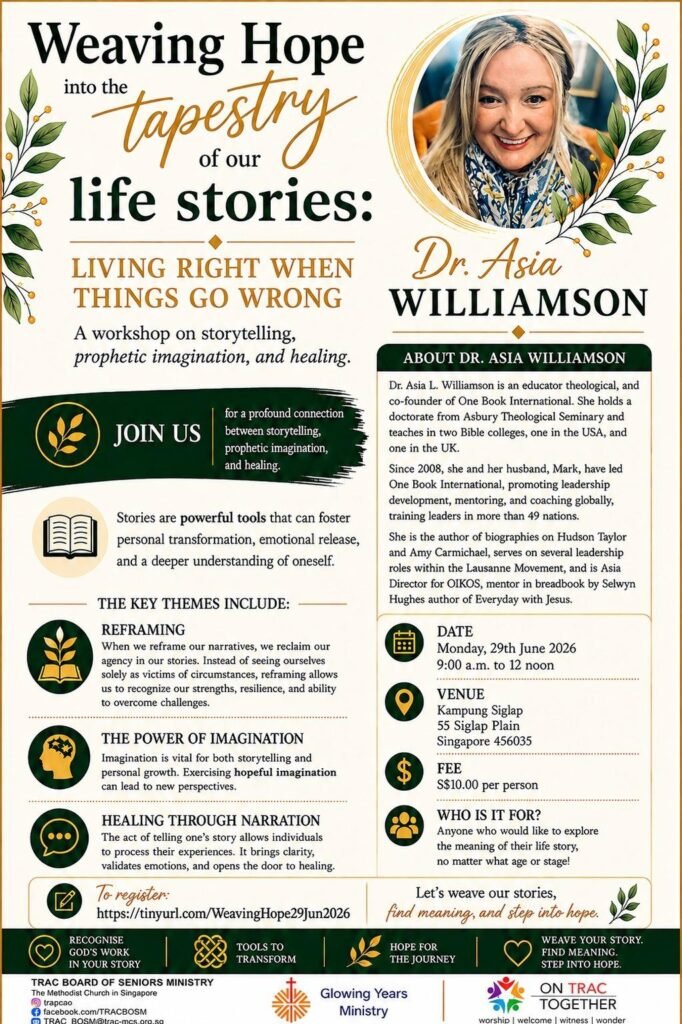
I didn’t have to think twice about signing up for Dr. Asia Williamson’s storytelling workshop, Weaving Hope into the Tapestry of Our Life Stories. The title alone resonated with me.
The word “story” always catches my attention.
During the workshop, Dr Williamson said: “Everyone has a story but not everyone has a testimony.”
What is the difference between a story and a testimony?
How do we turn our stories into testimonies?
Back in 2010, after serving with a mission organisation for 20 years, I stepped into a new calling as a Story Coach. Since then, I’ve had the privilege of teaching digital storytelling to marketplace professionals and everyday, non-technical homemakers alike. My greatest passion, however, has been helping Christians share their testimonies with greater clarity, authenticity, and impact.
Even after years of teaching, there’s always something new to learn from a fellow facilitator. That’s one of the joys of being a lifelong learner.
What is the difference between a story and a testimony?
I love the word weaving. Those of us who enjoy cross-stitch know that beneath every beautiful piece of needlework lies a tangled, seemingly chaotic web of crisscrossing threads. In much the same way, both living our lives and telling our stories require the patient work of weaving scattered moments, joys, and struggles into something meaningful and beautiful.
A story is a sequence of events unfolding over time. A testimony, on the other hand, is the frame or lens through which we interpret that story, giving it meaning and purpose. It’s helping others see our stories through our eyes. It is in our testimonies that we weave the message of hope, revealing how God’s presence and faithfulness have shaped the events of our lives.
Why is it important to be ready with our testimonies?
We all have stories worth telling, yet too often we tell them in ways that fail to capture their true beauty and power. Hollywood—and now AI—can make fictional stories feel vivid and believable. Yet when it comes to sharing the amazing things God has done, we sometimes present them in ways that seem flat or uninspiring. It’s time for an upgrade in how we tell our testimonies—one that reflects the wonder, hope, and life-changing power of God’s work, giving Him the glory He deserves.
Revelations 12 tells us that in the face of the accuser’s incessant accusations, God’s people overcame Satan the accuser by (1) the blood of the Lamb and (2) the word of their testimonies.
And they have conquered him by the blood of the Lamb and by the word of their testimony,
for they loved not their lives even unto death. – Revelation s 12:11, ESV
We overcome evil when we walk the talk (love not our lives even unto death) and talk the walk (speak forth our testimonies).
How do we turn our stories into testimonies?
TIP: Storytelling is totally God’s idea. HIStory is HIS story. Journaling is a good place to begin.
- Through journaling, we see how our stories weave into HIS story.
- We journal so we don’t forget what God has done for us.
- Over time, journaling helps us see patterns and growth in our lives.
- These in turn give greater clarity to our inclinations and calling to where our Father might be leading us to.
Sharing our testimonies is about sharing Christ’s finished work on the Cross (his life, death, and resurrection). Every day is a story. Today is as good a time as any to start or restart your journaling.